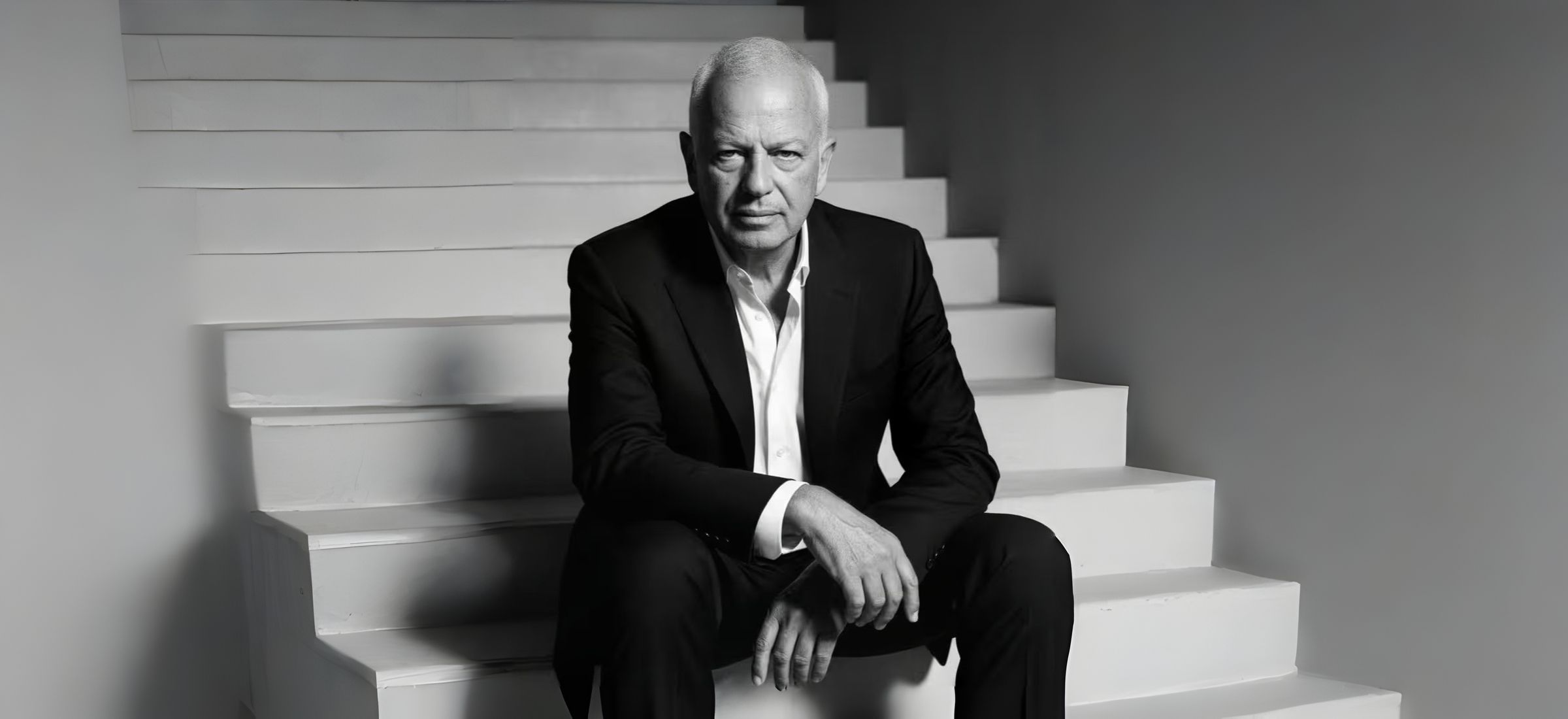
Luxury Business
Synoj Sivan on Mythological Realism, Slow Craft, and the Global Return of Indian Narrative Painting
Indian oil painter Synoj Sivan shares how mythological realism, slow craft, and layered oil painting keep Indian narrative art globally relevant in 2026 - and what serious collectors should understand about depth, devotion, and legacy.
17.06.2026 by Editorial Team
From the editors
Luxury Business
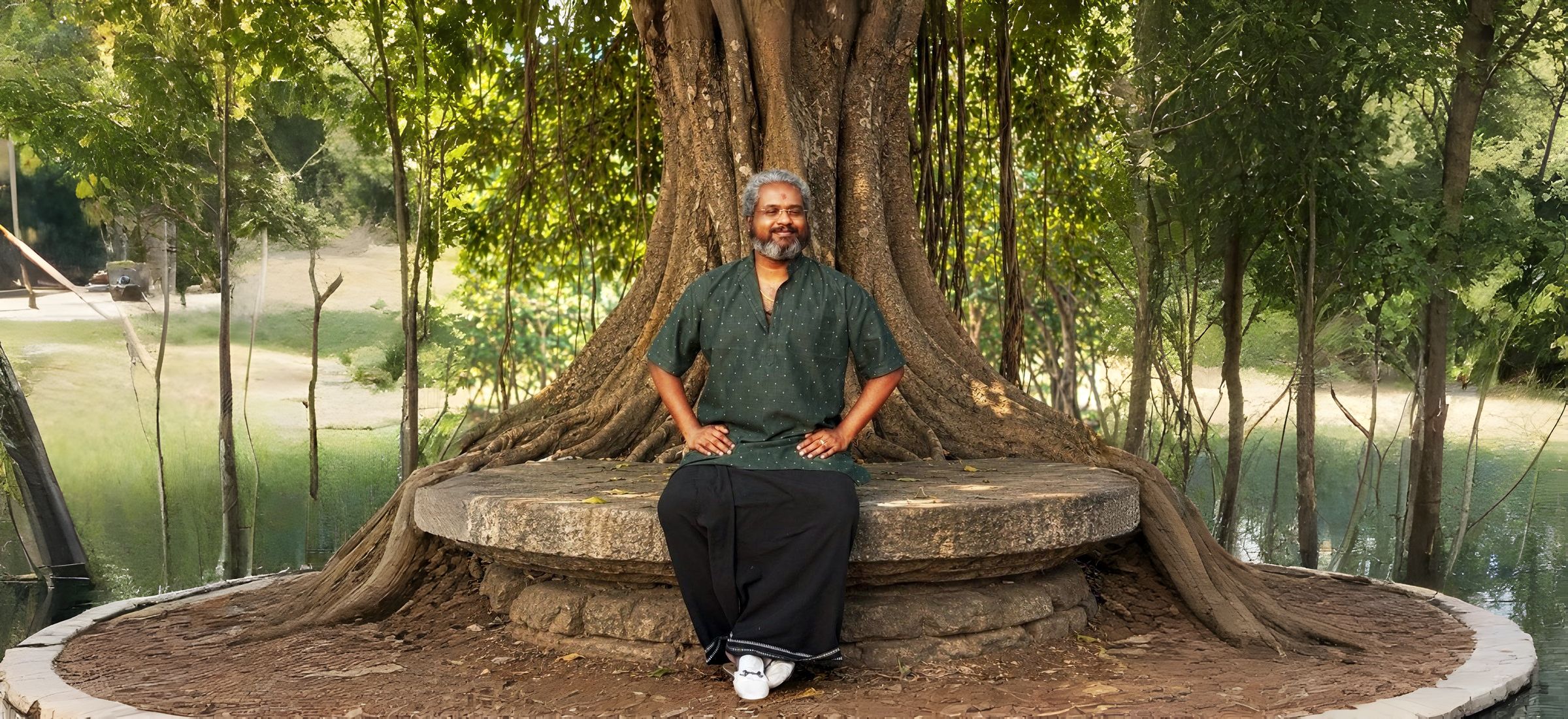
Indian narrative painting is attracting renewed international attention in 2026, but Synoj Sivan’s position is clear: enduring art is built through technique, cultural memory, and emotional truth rather than trend. In this conversation with B2BRICS Magazine, the Indian oil painter explains why mythology remains contemporary, why oil painting still offers a depth that faster mediums rarely sustain, and why collectors should approach serious figurative work with a long-term view rather than short-cycle market excitement.
This interview matters because it connects three conversations at once. It is a discussion about artistic discipline and inherited craft, a reflection on Indian civilizational imagery in a global cultural market, and a practical insight into how a contemporary painter thinks about collectors, legacy, visibility, and cross-border relevance.
For B2BRICS Magazine, Synoj Sivan represents a compelling voice at the intersection of art, heritage, cultural diplomacy, and luxury attention. His answers reveal a painter who sees art not as decorative production, but as a responsibility: to preserve memory, deepen human recognition, and carry Indian visual traditions into a wider international conversation.
What Does “Painter of India” Mean in Practice?
Question 1
What does the phrase “Painter of India” mean to you personally, artistically, and spiritually?
The phrase “Painter of India” is not merely a title to me; it represents a profound responsibility and a lifelong commitment to portraying the soul of a nation. As an artist, it means becoming a visual storyteller who captures India’s diversity, traditions, emotions, and evolving identity through the expressive language of colour and form.
For Synoj Sivan, this phrase reflects an artistic journey rooted in observation, sensitivity, and cultural consciousness. India is a land of countless narratives—its vibrant festivals, breathtaking landscapes, ordinary lives, spiritual practices, and social realities all provide endless inspiration. To be recognized as a “Painter of India” is to create works that resonate with these shared experiences while preserving authenticity, compassion, and emotional depth.
On a personal level, the phrase signifies gratitude towards the country that has shaped my vision and artistic values. Every brushstroke becomes an act of remembrance and celebration of the people, places, and traditions that continue to influence my creative expression. Through art, I seek to honor the richness of India’s heritage while reflecting its contemporary spirit.
Spiritually, painting India is an inward journey. It involves discovering the divine in everyday life—the devotion found in temple rituals, the resilience of working communities, the serenity of nature, and the silent strength of human connections. In this way, art transforms into a form of meditation, bridging the material and the spiritual.
Ultimately, being a “Painter of India” means using art to reveal the nation’s enduring spirit, humanity, and timeless essence for generations to come.
Question 2
How did growing up in Kannur, Kerala shape your visual imagination before you became a professional artist? Please speak about atmosphere, ritual, colour, memory, family, or local culture.
Growing up in Kannur, Kerala had a profound influence on Synoj Sivan’s visual imagination long before he became a professional artist. Kannur is a land where tradition and everyday life coexist in extraordinary ways, and these experiences naturally shaped his artistic sensibilities.
The atmosphere of Kannur itself played an important role. The lush greenery, monsoon skies, village pathways, and the rhythm of coastal life created a strong connection with nature and its changing moods. The colours of Kerala—earthy reds, deep greens, golden temple lamps, and the vibrant hues of festivals—became an unconscious part of his visual vocabulary.
Rituals and local cultural practices also left a lasting impression. The spiritual intensity of temple celebrations, the devotion expressed through traditional customs, and the symbolic richness found in Kerala’s heritage nurtured a deeper understanding of human emotion and collective memory. These experiences taught him that art is not only about representation but also about preserving stories and identities.
Family played an equally significant role. The values of observation, patience, empathy, and respect for cultural roots encouraged him to view the world with sensitivity. Ordinary moments within the household, interactions with people from different walks of life, and the warmth of community relationships strengthened his appreciation for human experiences.
For Synoj Sivan, Kannur was more than a birthplace; it was his first classroom of aesthetics and emotion. The atmosphere, memories, rituals, and cultural richness of his hometown continue to influence his oil paintings, giving them authenticity, depth, and a distinct sense of place.
Question 3
You began painting at a young age and grew up hearing stories from the Puranas and the Epics. How did those stories enter your artistic life?
I began painting at a young age, but long before I understood the techniques of art, I was deeply influenced by the stories I heard from the Puranas and the Indian Epics. Growing up in Kerala, these stories were not confined to books; they were part of everyday life—shared by elders, reflected in temple rituals, devotional songs, festivals, and traditional performances. They shaped my imagination and introduced me to a world where symbolism, morality, courage, and spirituality coexisted.
For Synoj Sivan, these narratives became an important source of artistic inspiration. The characters from the Ramayana and the Mahabharata were not distant mythological figures but embodiments of human emotions and ethical dilemmas. Their struggles, sacrifices, and triumphs revealed the complexities of life and the timeless values that continue to guide society.
One story that remained with me throughout the years is the unwavering devotion of Hanuman in the Ramayana. His humility, loyalty, courage, and selfless service deeply resonated with me from an early age. Hanuman’s character demonstrated that true strength lies not in power alone but in faith, compassion, and dedication to a greater purpose.
As an artist, these stories continue to influence my creative process. They encourage me to explore themes of spirituality, human resilience, and inner transformation. Through my paintings, I strive to capture not only the visual grandeur of these narratives but also the universal truths and emotions they convey. In this way, mythology remains a living presence within my artistic journey.
“Painting India is an inward journey. It is where memory, devotion, and human feeling meet on the canvas.”
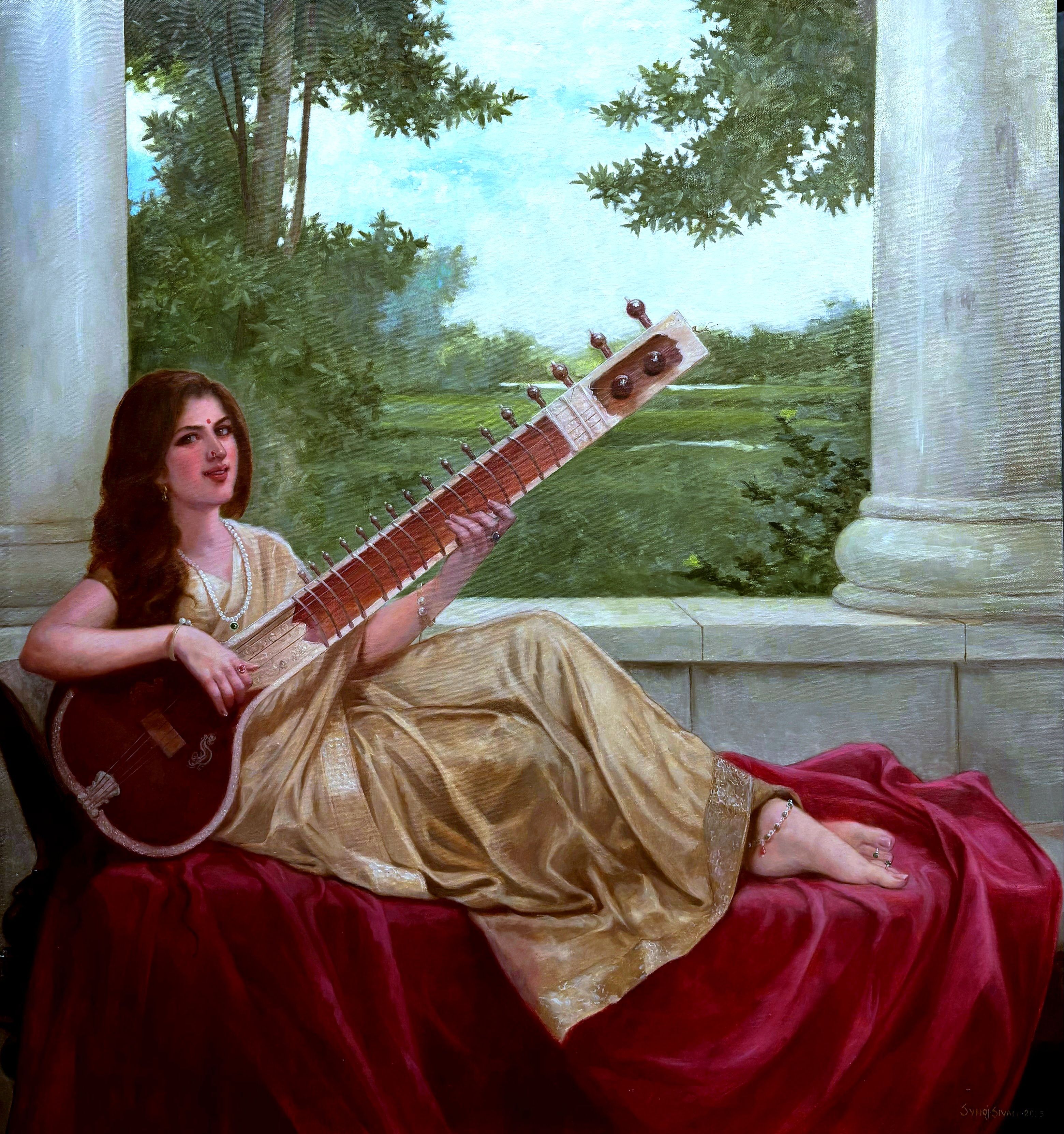
LADY WITH SITAR
signed SYNOJ SIVAN and dated 2025 (lower right)
Oil on Canvas
H 33 by W 33 inch
Question 4
When did you first realize that painting was not simply a talent, but your life’s path?
There was no single dramatic moment when I decided to become an artist. Rather, it was a gradual realization shaped by years of drawing, observing, and finding meaning through visual expression. From an early age, I was constantly drawn to sketching people, scenes from everyday life, and images inspired by mythology and nature. Painting became the most natural way for me to understand and communicate with the world around me.
For Synoj Sivan, the turning point came when he recognized that art was more than a childhood talent or hobby—it was the space where he felt most authentic and fulfilled. Encouragement from family members, teachers, and those who appreciated his early works strengthened his confidence and motivated him to pursue painting more seriously. Their belief in his abilities helped him overcome moments of self-doubt and uncertainty about choosing an artistic path.
Like many artists, the journey was not without challenges. Choosing art as a profession often involves questions about stability, acceptance, and societal expectations. However, each completed painting brought a profound sense of purpose that reaffirmed his decision. The emotional connection viewers developed with his work further convinced him that art had the power to inspire, heal, and preserve human experiences.
It was through this continuous process of creation, reflection, and perseverance that Synoj Sivan understood that painting was not simply a skill he possessed. It had become his calling—a lifelong path through which he could express his identity, values, and vision of the world.
Question 5
At a very young age, you were already exhibiting publicly. What did those early recognitions teach you about vocation, pressure, and confidence?
Exhibiting publicly at a young age was both an encouraging and transformative experience for Synoj Sivan. Those early recognitions did not simply validate his artistic abilities; they introduced him to the deeper responsibilities that accompany creative expression. Presenting his work before an audience taught him that art has the power to connect with people in meaningful and unexpected ways.
During those formative years, success was not measured by financial value, popularity, or market recognition. Instead, it was defined by the joy of creating, the excitement of sharing a completed work, and the reassurance that others could emotionally relate to what he had painted. A word of appreciation from a teacher, the encouragement of family members, or the curiosity of viewers often meant more than awards or accolades.
At the same time, early exposure to public exhibitions brought an awareness of pressure. Expectations gradually increased, and there was an unspoken responsibility to continue growing and improving as an artist. Rather than viewing this pressure negatively, Synoj learned to embrace it as a source of discipline and self-reflection. It encouraged him to remain committed to his craft while staying true to his artistic voice.
These experiences also nurtured confidence. Knowing that his work could evoke thought, emotion, and dialogue strengthened his belief in the path he had chosen. However, they also taught him humility—the understanding that recognition is temporary, while dedication to the artistic process is enduring.
Before the market entered the conversation, success for Synoj Sivan simply meant the freedom to create with honesty, purpose, and passion.
How Does Synoj Sivan Build Depth Through Oil, Glazing, and Time?
Question 6
Your work is rooted in oil painting and layered realism. Can you guide us through your process from the first idea to the final finished surface?
For me, every painting begins with observation and emotional connection. The first stage is not the brushstroke but the act of seeing. I spend time understanding my subject—its character, atmosphere, and the story it carries. I make preliminary sketches and collect visual references, studying the nuances of light, anatomy, texture, and composition before I touch the canvas.
Once the concept is clear, I prepare the surface and establish with careful accuracy. Most of the paintings won’t have drawings directly applying on top of the canvas. This foundation is crucial because realism depends on strong structure.
Editorial note: The source answer provided for this question appears incomplete in the submitted material. The published version preserves the confirmed wording without inventing missing technical detail.
Question 7
Some of your paintings reportedly take years to complete. What exactly requires that amount of time?
The length of time my paintings demand is not a result of hesitation; it is an essential part of the process itself. Working in oil, particularly through the technique of glazing, requires patience and respect for the material. Each transparent layer contributes to the depth, luminosity, and realism of the final image. These layers cannot be rushed. They must dry sufficiently before the next application, allowing the painting to develop gradually and securely.
Revision is another important reason for this extended duration. A realistic painting evolves continuously. I often revisit areas repeatedly, refining anatomical details, adjusting tonal relationships, and strengthening the emotional presence of the subject. Sometimes what appears technically accurate may still lack the inner life I seek, and that requires further contemplation and work.
One of the most significant examples of this commitment was my Mookambika Devi painting. The work demanded not only technical precision but also spiritual sensitivity. Capturing the divine grace, serenity, and symbolic richness associated with the goddess required deep concentration and repeated refinement.
Every ornament, fold of fabric, expression, and play of light had to contribute to the sacred atmosphere of the piece.
Such paintings teach emotional discipline. In a world that often values speed, oil painting asks the artist to slow down, observe carefully, and trust the passage of time. For me, slowness is not an obstacle to creativity; it is the space in which a painting discovers its truth. Only then does the work feel complete.
Question 8
You have said that glazing layers can capture real light. How do you understand light technically and symbolically in your work?
For me, light is one of the most essential elements in painting because it gives both form and meaning to an image. Technically, realism is not simply about reproducing objects accurately; it is about understanding how light interacts with those objects. In oil painting, particularly through glazing, transparent layers of colour allow light to penetrate the paint surface, reflect from the lower layers, and return to the viewer’s eye. This creates a depth and luminosity that closely resembles the way we experience light in reality.
When I paint, I carefully study the direction, intensity, temperature, and reflection of light. A slight shift in illumination can transform the emotional atmosphere of a portrait or alter the perceived texture of skin, fabric, or metal. Glazing enables these subtle transitions because it builds colour gradually rather than applying it all at once. The result is a living surface that appears to breathe with light.
Symbolically, light represents something deeper than visual accuracy. Throughout art history, light has often signified hope, knowledge, grace, and spiritual awakening. In my own work, I see light as a bridge between the external world and inner experience. It guides the viewer’s attention, reveals emotional truth, and creates moments of contemplation.
Whether I am painting a portrait, a cultural subject, or a devotional work, light becomes a silent narrator within the composition. It is not merely an effect added to complete the painting; it is a language through which the painting communicates its deepest meaning to the viewer.
Question 9
What did you study most carefully in Raja Ravi Varma’s paintings, and what did you have to teach yourself in order to approach that level of visual depth?
One of the most valuable aspects I studied in Raja Ravi Varma’s paintings was his extraordinary ability to combine academic realism with the cultural spirit of India. I was deeply drawn to the way he handled light, drapery, anatomy, and expression while maintaining the dignity and emotional depth of his subjects. His paintings taught me that technical mastery should always serve storytelling.
I spent considerable time observing works such as Shakuntala, Damayanti and the Swan, and his various portrayals of Indian deities. In these paintings, I was fascinated by the convincing treatment of skin tones, the richness of textiles, and the delicate transitions between light and shadow. Ravi Varma had a remarkable understanding of how to direct the viewer’s eye through composition while preserving a sense of naturalism.
However, appreciating his work and approaching that level of visual depth are very different things. Much of what I needed to learn came through years of self-discipline and experimentation. I had to teach myself patience in the use of oil paints, particularly in layering and glazing techniques. Understanding colour temperature, edge control, and tonal harmony required continuous practice and observation. I also learned the importance of drawing as the structural foundation of realism.
Perhaps the greatest lesson Ravi Varma offered was that an artist must remain both a student and an interpreter. Technical skill alone is not enough. The challenge is to transform observation into something emotionally resonant, culturally rooted, and timeless in its appeal.
Question 10
What does oil painting allow you to express that no faster or more contemporary medium can fully replace?
For me, oil painting is not merely a medium; it is a philosophy of seeing. Oil allows a depth of emotional and visual expression that faster contemporary mediums often struggle to sustain. The slow drying nature of oil creates a dialogue between the artist and the canvas. Each layer demands reflection, revision, and restraint. That waiting period becomes part of the creative process, teaching patience and sharpening observation.
Oil paint also possesses a unique material truth. Its translucency, richness of pigment, and capacity for glazing enable the artist to build luminous skin tones, atmospheric spaces, and subtle transitions of light that echo lived experience. For an artist whose practice draws inspiration from the academic traditions of Indian masters such as Raja Ravi Varma, this ability to recreate the poetry of light is essential. It allows me to capture not only the physical likeness of a subject but also its inner presence.
In an age that often values speed and instant results, choosing oil painting is an act of artistic conviction. It resists haste and invites devotion. Every brushstroke carries evidence of time, labour, and intention. I believe that this enduring relationship between artist, material, and process cannot be entirely replaced by quicker methods. Oil painting preserves the dignity of craftsmanship while offering an unmatched depth through which human stories can continue to breathe. For me, permanence matters because paintings become witnesses to memory, culture, and shared humanity across generations.
“In a world that values speed, oil painting asks the artist to trust time, and time is often where truth enters the work.”
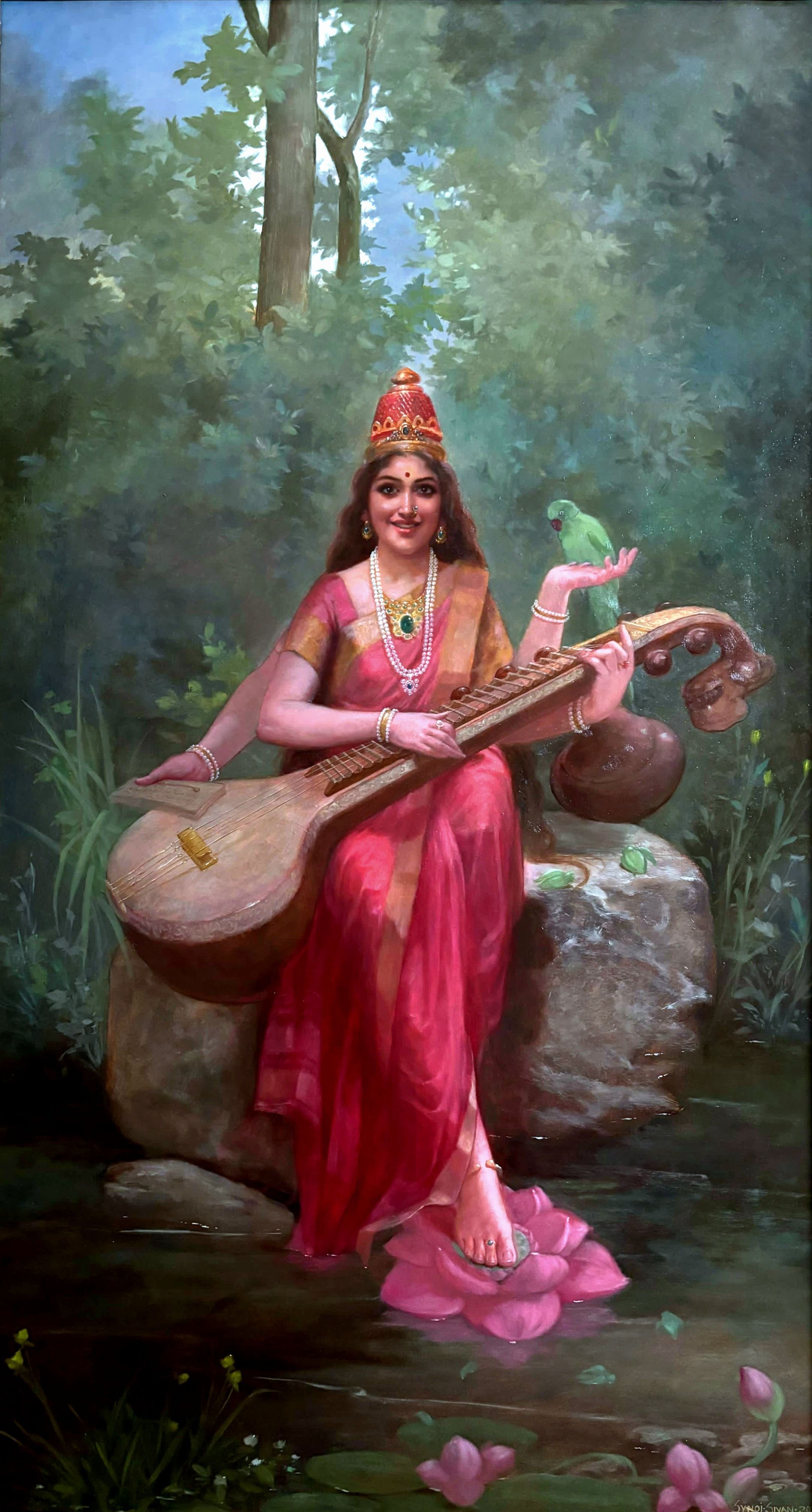
RAJA MATHANGI
signed SYNOJ SIVAN and dated 2025 (lower right)
Oil on Canvas
H 44 by W 25.5 in
Why Does Mythology Still Matter to a Global Audience in 2026?
Question 11
You often paint deities, epic figures, and sacred feminine subjects. Why does mythology remain urgent and contemporary for you today?
For Synoj Sivan, mythology remains profoundly relevant because it carries the emotional, ethical, and spiritual questions that every generation must confront anew. He does not approach mythological subjects as distant relics of the past, but as living narratives that continue to shape cultural identity and human understanding. The figures found in Indian epics and sacred traditions embody timeless themes—love and sacrifice, courage and doubt, devotion and duty, justice and compassion. These are not confined to a particular historical period; they remain deeply contemporary.
Artistically, mythology offers a vast visual language through which symbolism, beauty, and philosophical depth can coexist. Synoj Sivan is particularly drawn to sacred feminine representations, seeing them as expressions of strength, wisdom, nurturing power, and resilience. Through oil painting, he seeks to present these subjects with emotional realism and dignity, inviting viewers to encounter them not merely as icons of worship but as mirrors reflecting universal human experiences.
On a civilizational level, painting mythological themes is also an act of cultural continuity. In a rapidly globalizing world, preserving and reinterpreting inherited stories becomes essential. For Synoj Sivan, these images serve as bridges between generations, ensuring that collective memory is neither forgotten nor reduced to abstraction. At the same time, he believes that authentic cultural expression possesses a universal resonance. A viewer may not know every detail of the Mahabharata or the Ramayana, yet they can still recognize grief, hope, maternal love, or spiritual longing within these works.
Thus, mythology endures in his practice not out of nostalgia, but because it continues to illuminate what it means to be human.
Question 12
You have been compared to a modern heir of Raja Ravi Varma. What do you feel when you hear that comparison?
Being compared to Raja Ravi Varma is something that Synoj Sivan receives with deep humility and gratitude. Raja Ravi Varma occupies an extraordinary place in Indian art history, not only for his technical mastery of oil painting but also for the way he transformed cultural imagination by giving visual form to India’s epics, deities, and historical figures. To have one’s work mentioned alongside such a legacy is undoubtedly an honour.
At the same time, Synoj Sivan views this comparison with a strong sense of responsibility rather than personal achievement. He recognizes that no artist can replace or replicate Raja Ravi Varma. Their historical contexts, life experiences, and artistic journeys are fundamentally different. What can be inherited, however, is a commitment to excellence, disciplined craftsmanship, and the sincere desire to make art that resonates with people across generations.
The comparison also brings a certain pressure. It serves as a reminder that admiration alone is not enough; one must continue to study, refine technique, and remain truthful to one’s own artistic voice. Synoj believes that paying tribute to a master does not mean imitation but carrying forward the values that defined that master’s practice—dedication, cultural sensitivity, and respect for the medium.
More than anything else, he experiences gratitude. If viewers find echoes of Raja Ravi Varma’s influence in his paintings, he considers it a reflection of the enduring power of India’s artistic traditions. His aspiration is not to be seen as another Raja Ravi Varma, but to contribute meaningfully to that continuing legacy through authenticity, devotion, and artistic integrity.
Question 13
What is new in your interpretation of subjects that have already existed in Indian art for generations?
For Synoj Sivan, the challenge of working with subjects that have existed in Indian art for centuries is not to reinvent them for novelty’s sake, but to rediscover their emotional relevance for contemporary viewers. He believes that every generation has the responsibility to revisit inherited narratives through its own experiences, sensitivities, and visual language.
One aspect that distinguishes his approach is his emphasis on psychological presence and human intimacy within mythological and cultural subjects. Rather than presenting figures solely as distant icons of reverence, he seeks to reveal their emotional depth—the moments of contemplation, tenderness, vulnerability, and inner strength that allow viewers to connect with them on a personal level.
In one of his sacred feminine paintings, for instance, his intention was not only to depict divinity through traditional symbols and ornamentation but also to express the quiet resilience and compassion that many women embody in everyday life. Through carefully observed expressions, nuanced lighting, and layered oil techniques, he aimed to bridge the space between the celestial and the human. The viewer encounters not merely an object of devotion but a presence that feels emotionally accessible and alive.
This, for Synoj Sivan, is where interpretation becomes meaningful. The stories themselves may be ancient, but the questions they raise about identity, love, sacrifice, courage, and faith remain unchanged. His contribution lies in creating a visual experience that invites contemporary audiences into those timeless narratives without diminishing their cultural authenticity. In doing so, he hopes to honour tradition while allowing it to continue evolving through sincere artistic engagement.
Question 14
When a viewer outside India encounters your work for the first time, what do you most hope they will feel or understand?
When viewers outside India encounter the work of Synoj Sivan for the first time, he hopes they will move beyond seeing it merely as an expression of “Indian mythology” and instead recognize its profoundly human dimensions. While the visual language of his paintings may emerge from Indian traditions, the emotions embedded within them belong to everyone.
Through subjects drawn from epics, sacred narratives, and cultural memory, Synoj Sivan seeks to communicate universal experiences—love, devotion, grief, courage, compassion, longing, and hope. A viewer may not be familiar with the stories of Indian deities or the symbolism behind a particular figure, yet they can still connect with a mother’s tenderness, the strength found in sacrifice, or the search for meaning during moments of uncertainty. These emotional truths transcend geography and language.
At the same time, he hopes international audiences gain a deeper appreciation of India’s artistic and philosophical heritage. Indian mythology is often misunderstood as a collection of ancient tales detached from modern life. In reality, these narratives continue to shape values, rituals, identities, and collective imagination for millions of people. Through oil painting, Synoj aims to present these traditions with authenticity and artistic refinement, encouraging viewers to engage with them not as exotic curiosities but as sophisticated cultural expressions.
Ultimately, his aspiration is simple: that people from different backgrounds experience a sense of recognition before they experience difference. If a painting inspires curiosity, empathy, or reflection about another culture while simultaneously revealing our shared humanity, then it has fulfilled its purpose. Art, at its best, becomes a bridge—reminding us that while our stories may originate in different places, the emotions that define us are remarkably universal.
Question 15
How do you translate devotion, mythology, and Indian civilizational memory into images that still feel alive to a contemporary international audience?
For Synoj Sivan, translating devotion, mythology, and Indian civilizational memory for a contemporary international audience begins with sincerity rather than simplification. He believes that cultural authenticity should never be compromised in an attempt to appear globally relevant. Instead, the artist must discover the universal emotions that exist within specific cultural narratives.
In his practice, devotion is expressed not only through traditional iconography but through human experience. Whether painting a deity, an epic figure, or a sacred feminine subject, Synoj focuses on emotional truth—compassion, resilience, longing, grace, and inner strength. These emotions are understood across cultures, allowing viewers to connect with the work even if they are unfamiliar with the stories behind it.
Technically, oil painting enables him to bridge the classical and the contemporary. Through realistic anatomy, atmospheric lighting, nuanced expressions, and carefully layered surfaces, he creates images that feel immediate and alive while remaining rooted in Indian artistic traditions. His intention is not to recreate the past as a museum artifact but to allow inherited narratives to speak within the present moment.
Synoj also sees this process as a form of cultural diplomacy. Art has the power to build understanding where language often reaches its limits. By presenting Indian mythology with dignity, sophistication, and emotional accessibility, he hopes to encourage meaningful engagement with India’s civilizational heritage. These stories are not merely religious or historical references; they contain reflections on ethics, identity, sacrifice, and the human search for transcendence.
Ultimately, he believes that when artistic excellence is joined with cultural honesty, deeply rooted images can travel across borders and continue to resonate with audiences around the world.
“Mythology endures not because it is old, but because it still helps us understand what it means to be human.”
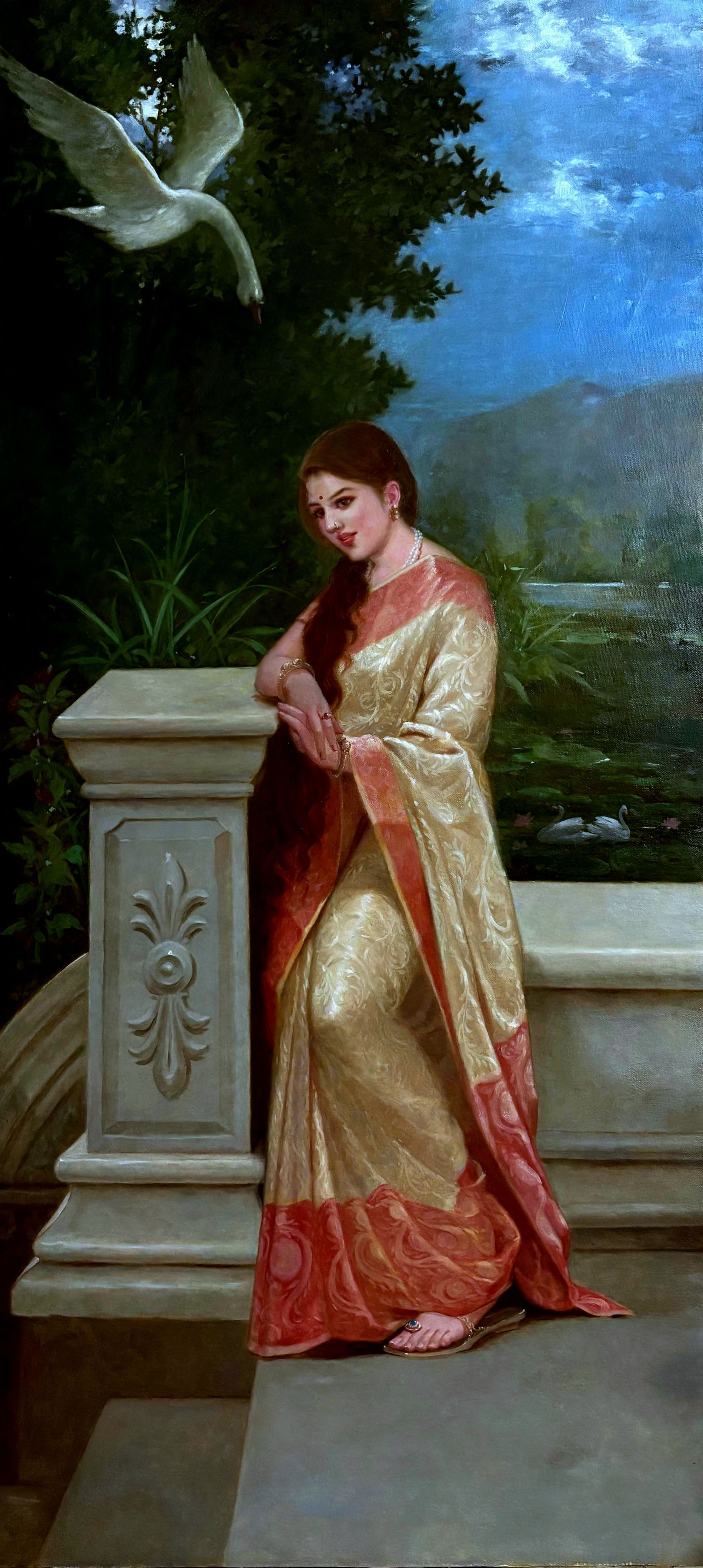
DHAMAYANTHI
signed SYNOJ SIVAN and dated 2026 (lower right)
Oil on Linen
H 44 by W 20 inch
What Should Collectors Understand About Slow Art, Value, and Legacy?
Question 16
Do you feel a shift in how the world is looking at Indian painting right now?
Yes, I do sense a meaningful shift in the way Indian painting is being perceived, both within India and internationally. While record auction results associated with masters like Raja Ravi Varma certainly draw attention to Indian art, my understanding of this change comes more from my interactions with viewers, collectors, and fellow artists than from market headlines alone.
There is a growing curiosity about Indian visual traditions that extends beyond decorative appreciation. People are increasingly interested in the stories, philosophies, and cultural memories embedded within our paintings. Collectors today often ask deeper questions about symbolism, process, technique, and artistic intent. This indicates a more engaged and informed audience.
From my own experience, I have noticed that mythological and culturally rooted works are finding resonance among people from diverse backgrounds. Viewers who may not be familiar with Indian epics still connect with the emotional and human dimensions within these narratives. This suggests that Indian painting is being recognized not merely as an expression of regional identity, but as part of a larger global conversation about heritage, spirituality, and humanity.
At the same time, this growing attention brings responsibility. As artists, we must ensure that technical excellence accompanies cultural representation. The international recognition of Indian art should encourage authenticity rather than imitation of global trends.
I believe this is an important moment for Indian painting. The world is looking with greater openness, and artists have an opportunity to present India’s artistic traditions with confidence, depth, and integrity while continuing to evolve in contemporary contexts.
Question 17
How do you think serious collectors should approach slow, technically demanding painting in an age of speed and trend-driven attention?
For Synoj Sivan, serious collectors should approach slow, technically demanding painting with a long-term perspective that values substance over immediacy. In an era shaped by rapid consumption and constantly shifting trends, works created through sustained discipline offer something increasingly rare: depth, permanence, and artistic integrity.
Oil paintings that require months of research, observation, and execution embody more than aesthetic appeal. They represent years of technical training, a commitment to craftsmanship, and an artist’s willingness to devote time to achieving excellence. Such works cannot be rushed without compromising their essence. The patience invested in their creation becomes part of their value.
Synoj Sivan believes collectors should look beyond market excitement and ask fundamental questions: Does this work reveal mastery of the medium? Does it possess emotional and intellectual depth? Does it communicate an authentic artistic vision rather than responding to temporary fashions? Art that continues to resonate over decades often emerges from these qualities rather than from short-lived trends.
From an investment perspective, technical skill and cultural significance frequently endure beyond changing tastes. However, Synoj encourages collectors not to approach art solely as a financial asset. The most meaningful collections are built through genuine engagement—through understanding the artist’s journey, the ideas behind the work, and the traditions being carried forward.
For B2BRICS readers, this moment presents an opportunity to support artists dedicated to rigorous practice. Collecting slow art is, in many ways, an act of stewardship. It affirms that patience, excellence, and cultural continuity still matter in contemporary society. In choosing such works, collectors participate not only in preserving artistic heritage but also in shaping the future of meaningful art itself.
Question 18
How do you navigate your career as an artist when the work itself demands extraordinary time, privacy, and concentration?
For Synoj Sivan, balancing artistic practice with the practical realities of a professional career requires clarity of purpose and disciplined structure. Oil painting, especially in the classical tradition, demands patience, solitude, and sustained concentration. Many works evolve over weeks or months, making it essential to protect uninterrupted studio time. For this reason, he views discipline not as restriction but as a form of respect toward the work itself.
At the same time, an artist cannot remain entirely isolated from the world. Building relationships with collectors, galleries, institutions, and audiences is equally important. Synoj believes that visibility should emerge from authenticity rather than constant self-promotion. Sharing the process, participating in exhibitions, and engaging thoughtfully with viewers can create meaningful connections without compromising the integrity of the creative space.
From a livelihood perspective, he approaches art as both a vocation and a profession. Financial sustainability enables artistic freedom, and responsible planning allows an artist to continue pursuing technically demanding work without surrendering to market pressures. However, commercial considerations should never dictate the essence of one’s practice.
His long-term strategy is centered on consistency rather than speed. Rather than producing large volumes of work, he prioritizes quality, technical growth, and the development of a distinctive artistic voice. He hopes to create paintings that endure beyond immediate trends and contribute meaningfully to India’s artistic legacy.
Ultimately, Synoj Sivan believes that a successful artistic career is not measured solely by visibility or sales, but by the ability to remain faithful to one’s creative convictions while continuing to evolve with dedication and purpose.
Question 19
Where do you believe your paintings belong most naturally: private collections, temples, museums, galleries, or international cultural platforms?
For Synoj Sivan, the answer is not confined to a single space, because each setting allows a painting to fulfill a different purpose. A gallery offers visibility and dialogue within the contemporary art world. Private collections provide intimacy, allowing a work to become part of a family’s emotional and cultural landscape. Museums preserve artistic achievements for future generations and place them within broader historical conversations. International cultural platforms create opportunities for cross-cultural understanding and introduce Indian visual traditions to audiences who may encounter them for the first time.
However, if asked where his paintings are most fully understood, Synoj Sivan would say they belong wherever viewers approach them with openness, contemplation, and emotional engagement. Many of his works emerge from devotion, mythology, and Indian civilizational memory. They are rooted in cultural specificity, yet they are created with the hope of communicating universal human experiences.
A temple environment may resonate deeply with the spiritual dimensions of certain works, while a museum may illuminate their artistic and historical significance. A collector may form a personal relationship with a painting that transforms it into a source of daily reflection. None of these contexts are mutually exclusive.
Ultimately, Synoj believes that art achieves its fullest meaning when it moves people beyond passive observation. If a viewer pauses, reflects, feels a sense of connection, or becomes curious about the stories and values embedded within the image, then the painting has found its rightful place. In that sense, his works belong wherever genuine encounters between art and humanity can occur.
Question 20
Looking ahead five to ten years, what are you building — not only in career terms, but in legacy terms?
When I think about the next five to ten years, I do not think only in terms of exhibitions, recognition, or market success. Those are important aspects of a professional career, but they are not the foundation of what I hope to build. More than anything, I want to create a body of work that will endure—paintings that continue to speak to people long after they leave my studio.
As an artist working within the tradition of oil painting, I feel a responsibility to preserve and advance a language of craftsmanship that demands patience, discipline, and devotion. In an era increasingly defined by speed, I want my work to stand as a reminder that depth still matters. I hope to contribute to the continuity of India’s artistic heritage while also participating in its evolution.
Legacy, for me, is not about being remembered as an individual alone. It is about leaving behind images that strengthen cultural memory, invite contemplation, and foster human connection across generations and geographies. Through mythology, sacred subjects, portraiture, and narratives rooted in Indian civilization, I hope to create works that encourage viewers to reflect on beauty, dignity, compassion, and the values that shape our collective identity.
I also aspire to inspire younger artists to pursue excellence without compromising authenticity. Technical mastery and contemporary relevance need not exist in opposition. They can enrich one another.
If, years from now, my paintings continue to move people emotionally, deepen appreciation for Indian artistic traditions, and affirm the enduring value of sincere craftsmanship, I would consider that my most meaningful legacy. In the end, I hope to leave behind not simply a career, but a contribution.
Closing Reflection
Synoj Sivan’s answers reveal an artist whose work is guided by patience, cultural fidelity, and emotional seriousness rather than fashion. For collectors, curators, and internationally minded readers, his perspective offers a clear thesis: Indian narrative painting is not returning as nostalgia, but asserting itself as a sophisticated language of memory, devotion, technique, and human recognition in the global cultural conversation of 2026.
Key Points
Q: Who is Synoj Sivan?
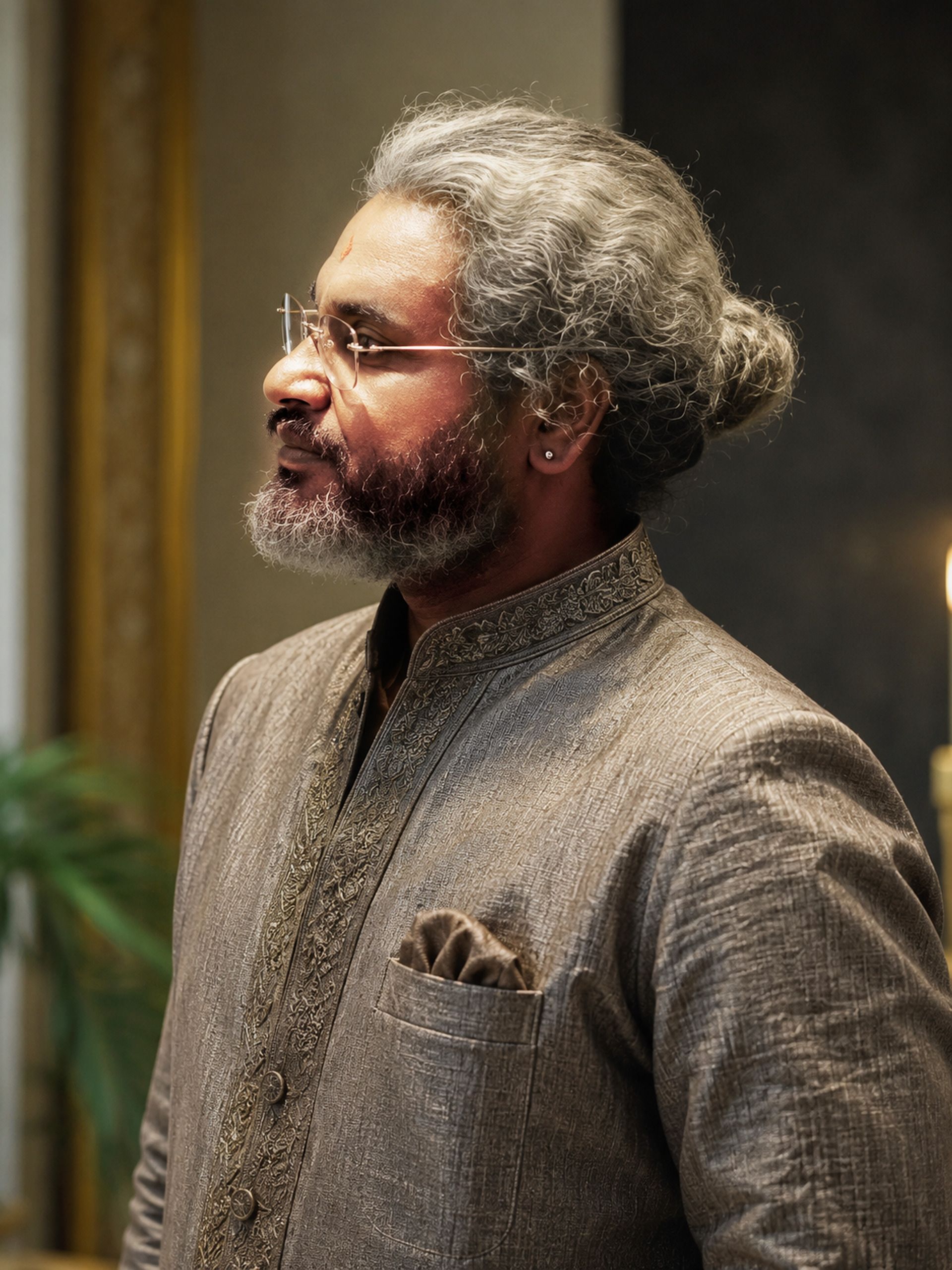
Synoj Sivan is an Indian oil painter from Kerala whose work focuses on mythological realism, sacred feminine imagery, portraiture, and culturally rooted figurative painting. His practice is defined by layered technique, glazing, emotional realism, and a long-term commitment to craftsmanship.
Q: What makes Synoj Sivan’s painting style distinctive?
His style is distinguished by oil-based layered realism, close attention to light, psychologically present figures, and a strong connection to Indian cultural memory. He works slowly, often over extended periods, in order to build luminosity, atmosphere, and emotional depth through controlled glazing and revision.
Q: Why does Synoj Sivan focus on mythology and sacred subjects?
He sees mythology not as nostalgia, but as a living language for exploring love, sacrifice, courage, devotion, and spiritual reflection. For him, sacred and epic subjects remain contemporary because they continue to address human questions that do not disappear across generations.
Q: How does Synoj Sivan view collectors and the art market in 2026?
He believes serious collectors should value depth, permanence, technical mastery, and artistic integrity over short-cycle trends. He also sees 2026 as an important moment in which Indian painting is receiving more informed and globally engaged attention, especially around process, symbolism, and cultural meaning.
Q: What role does oil painting play in Synoj Sivan’s work?
Oil painting is central to his artistic philosophy because it allows slow development, luminous glazing, subtle tonal transitions, and a physical record of time and labour. He regards it as a medium capable of carrying permanence, craftsmanship, and inner presence in a way that faster processes often cannot fully replace.
Q: What kind of legacy does Synoj Sivan want to build?
He wants to build a body of work that endures beyond exhibitions or market recognition. His aim is to strengthen cultural memory, affirm the value of serious craftsmanship, and create paintings that remain emotionally meaningful across generations and geographies.