Founders & CEOs
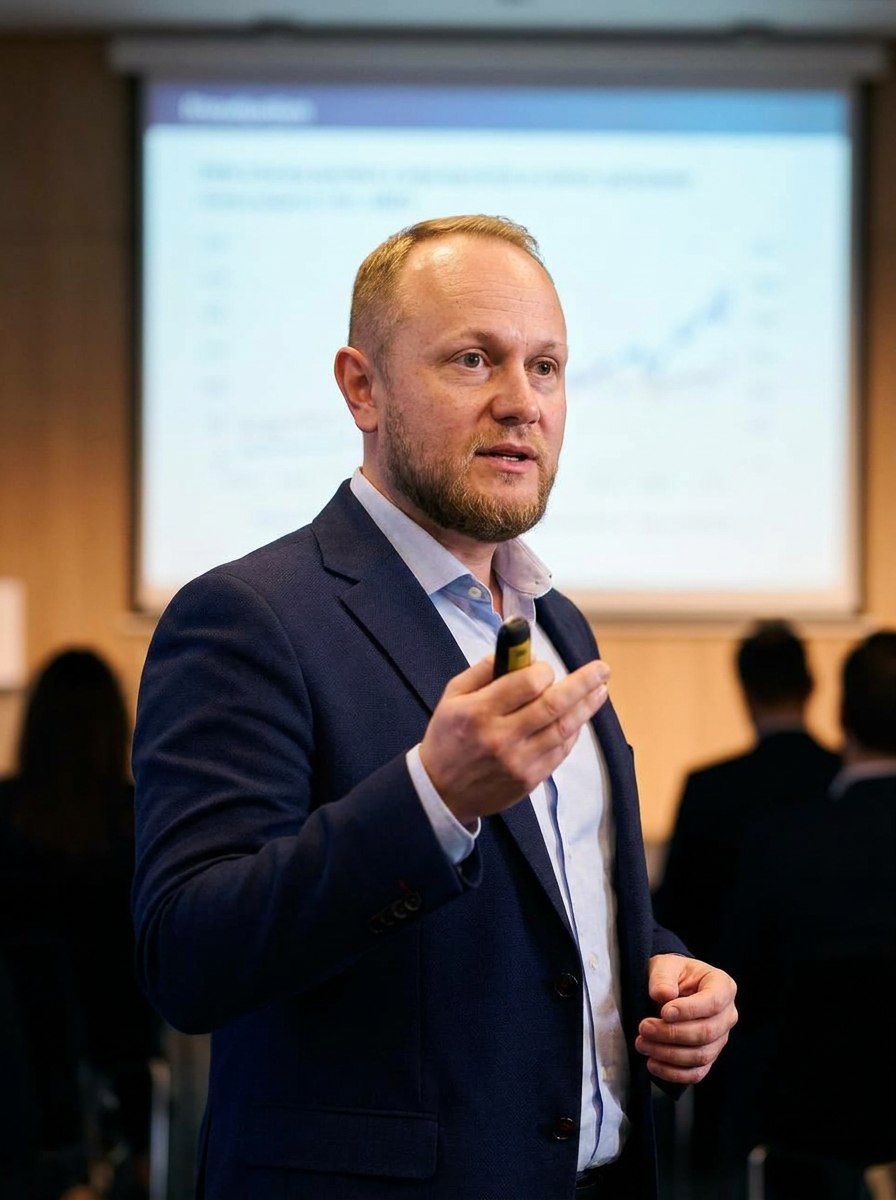
Aleksei Shturbin on AI-Driven Management, Founder Education, and Building Internal Competence Across BRICS Markets
Why AI becomes a management discipline only when founders keep competence, decision-making logic and execution capability inside the business.
25.06.2026 by Editorial Team

From the editors
AI is rapidly becoming a core management instrument rather than a peripheral technology choice, and in BRICS markets this shift is tightly linked to questions of control, speed, and operational discipline inside companies. For leaders operating in 2026, the real strategic question is no longer whether to adopt AI tools, but how to turn them into repeatable processes that live inside the business, instead of remaining one-off pilots or outsourced experiments. In this conversation, Aleksei Shturbin argues that AI transformation is first and foremost a management challenge: growth stalls not because markets are saturated, but because companies lose controllability at scale, make decisions on intuition instead of data, and fail to explain change in a way that teams can own. He explains why founder education is the true starting point, how the “strategist plus engineer” model works in practice, and what differentiates Russian, Middle Eastern and Southeast Asian leadership cultures in their approach to AI, ROI and risk. For BRICS-focused readers, this interview offers a practitioner’s view on where AI delivers measurable value in 2026, how to avoid dependency on vendors, and why building internal competence will separate long-term winners from those who merely “implemented tools”.
B2BRICS Magazine editors see the rise of practices like Zinin × Shturbin as an important signal of where the BRICS business conversation on AI is moving: away from abstract disruption narratives toward disciplined, P&L-linked transformation driven directly by founders and C-suite leaders. In markets from Russia and the wider CIS to the GCC and Southeast Asia, investor-grade dialogues are increasingly focused on where exactly AI unlocks margin, speed and scale, and what governance is required so that competence and value remain inside the company rather than on consultants’ slides. Against this backdrop, Shturbin’s cross-market operational track record and his insistence on working only with real processes, real data and accountable owners make his perspective particularly relevant for decision-makers navigating 2026–2030.
Personal Journey and the Shift from Corporates to AI Practice
Question 1
You went from manager to CEO - 1 in international companies. What turned out to be truly valuable from that experience – and what did you have to rethink once you started working for yourself?
The most valuable thing the corporate world gave me was scale of thinking and a discipline of results. When you are responsible for a P&L in the hundreds of millions, you stop believing in beautiful presentations and start believing in numbers, processes and the people who move them. That never left me: to this day I test any decision with a simple question – where is the money here, and who is accountable for it. At the same time, I had to completely rethink speed and distance to decisions when I stepped out of corporate roles. In a corporation, there are committees, approvals and quarters between idea and implementation, but when you work for yourself alongside a founder, the cycle compresses to days, which is disorienting at first but quickly becomes the space where real value is created. The breaking point came when I saw that my management experience, combined with AI, could give an owner something no slide-based consultant could – a working system inside the company rather than a report – and that was the moment it became obvious that it was time to build my own practice.
Question 2
You managed a 300 million dollar P&L across 36 markets. Which business behaviour patterns repeated regardless of country – and why did they become the backbone of your consulting approach today?
The core patterns I saw across markets are that growth stalls not because of the market, but because of controllability, because decisions are made on gut feeling where data already exists, and because teams resist unclear change rather than change itself. In practice, companies lose money at the seams between functions, not within the functions themselves; they sit on data that nobody has assembled into a management picture, so executives revert to intuition; and once people clearly see their personal upside in a change, the speed of adaptation increases dramatically. These patterns proved universal across Europe, the CIS and Asia, across categories and scales, which is why our approach today is built around management rather than technology. We start by finding where the company is losing speed and money, and then we embed AI precisely into those points – where it delivers measurable effect rather than where it happens to be fashionable. For us AI is a lever for a management problem, not an end in itself.
Question 3
What brought you to create the Zinin × Shturbin practice at this specific moment – and why did AI education for founders become the entry point?
I started this practice because I saw a costly gap: on one side there are owners who understand that AI is changing the rules but do not know where to start or whom to trust, and on the other side a vendor market that sells “we will implement it for you” and leaves the company dependent and without internal competence. The moment I met Tim and saw how he actually assembles working AI processes – not presentations, but systems that run in production – it became clear that the strategist–engineer pairing can close that gap. My role is to translate the founder’s agenda into the language of priorities and money, Tim’s role is to turn it into a system that runs inside the company, and the competence stays with the client. Founder education became our entry point because transformation starts with the person who makes the decisions: if the owner personally understands AI at the level of levers rather than magic, everything else moves; if not, any integration falls apart sooner or later.
“AI stops being hype and starts being management only when the person who owns the P&L understands it as a system of levers, not as a black box delegated to somebody else.”

Why Internal AI Competence and Real Processes Matter More Than Tools
Question 4
Your practice is built on the principle that knowledge must remain inside the company rather than leave with the vendor. How do you operationalise this – and what makes your format different from a corporate training or a course?
We operationalise “competence stays inside” by working only on real client processes, not on classroom cases. A corporate training gives knowledge in a vacuum – after it you are left with notes and zero change in how work is done – and a course gives theory that nobody is mandated to apply, but we come in differently: we take a real business task, whether sales funnel, reporting, content or lead handling, and build a working AI process for it together with the team. By the end of the programme the client does not get a certificate, but three tangible assets: a system that runs in their own environment, people inside who know how to evolve it, and a clear understanding of how to formulate the next task. We deliberately do not deliver “turnkey” solutions, because turnkey creates dependence on the vendor and kills competence. The difference is most visible in a typical session when we sit down with a function head and in one working block turn their routine into a process that starts saving them hours as soon as the following week – that is what real transfer of competence into the organisation looks like.
Question 5
You split roles: Tim leads on engineering, you lead on strategy. How does that actually work in engagements – and where do strategy and engineering intersect?
In practice, our split works because I hold the end-to-end business conversation with the owner while Tim simultaneously translates it into solution architecture. I talk about where money is lost, what the priorities are, and what we touch first and why, while he defines what exactly needs to be built, with which tools and how it slots into existing processes and systems. The intersection is at prioritisation, because you can automate ten different things but only a few will move money in the current quarter rather than just look impressive; at that moment you need both a strategic lens and a grounded view of what is technically realistic and stable. I cut options by business sense, Tim cuts them by engineering reality, and it is at that junction that robust decisions appear. We also run different conversations at different levels: with the owner I talk in terms of P&L and controllability, while Tim talks with the team in terms of concrete tools and hands-on execution, because if you mix these levels the owner gets bored by tool talk and the team drowns in strategy language.
“The right AI roadmap appears where a strategist is ruthlessly honest about money and an engineer is ruthlessly honest about feasibility – anything else is just a slide deck.”
Question 6
How do you diagnose a company’s readiness for AI transformation – and what are clear signals that it is too early?
Readiness for AI transformation is fundamentally a question of management maturity, not technical maturity. A company is ready when the owner is personally engaged and willing to invest time rather than just budget, when there are clear pain points with named owners so there is somewhere to embed AI, and when leadership is prepared to change processes rather than simply “add AI on top” of existing chaos. Conversely, it is too early when the request sounds like “implement AI for us” without a specific business problem, when the owner wants to fully delegate and not participate, or when there is no basic order in processes and data so that AI would only accelerate existing chaos. We are very direct with clients and say “too early” when we see these signals, because it is better to put management fundamentals in order first and only then amplify them with AI; launching transformation into an unprepared system just burns money and trust.
BRICS Leadership Cultures, Ideal Clients and Real AI ROI
Question 7
How does C-suite readiness for AI transformation differ between the Russian market and markets in the Middle East or Southeast Asia?
The main differences between these regions lie in decision-making culture rather than in technical maturity. In Russia the market is characterised by high speed and pragmatism: owners are willing to test quickly and are not afraid to sit down with the tools themselves, but they sometimes overestimate what can be done “fast” and underestimate the need for systematic work. The Middle East is primarily a market of relationships and status, where decisions at the top take longer and are tightly tied to trust and the reputation of whoever is making the proposal, but once that trust is built the scale of ambition and budgets is larger and the planning horizon is longer. Southeast Asia is pragmatic and oriented towards efficiency and numbers: leaders there quickly calculate ROI and are ready to implement anything that demonstrably works, but they expect a strong evidence base. Across BRICS C-suites one common thread is that AI is viewed as a question of competitiveness and control rather than as a gadget, so the conversation almost always starts with where the company is winning or losing on speed, not with a catalogue of tools.
Question 8
What types of companies or leaders are the best fit for your methodology?
Our methodology works best with owners and founders who personally make key decisions and want to understand AI themselves rather than simply close the topic by delegating it. Company size is secondary to leader type: the ideal client is someone prepared to invest their own time and let AI-enabled change touch their personal routines, not just those of their team. In practice this is most often mid-sized and fast-growing businesses that are mature enough to have structured processes and data, yet flexible enough to change them without six months of approvals. The sectors where results show quickest are those with many repetitive operations and text flows, such as sales and customer work, marketing and content, lead processing, analytics and reporting. A typical client is an owner or CEO whose company has hit a ceiling of controllability – revenue continues to rise while people and processes fail to keep up – and who already senses that “just hiring more people” leads into a dead end, so they are actively looking for ways to scale without inflating headcount.
Question 9
How does your operational experience with large retailers like X5, Magnit and Auchan change your view of where AI delivers real ROI – and where it is only the illusion of transformation?
Working with large retail chains teaches you to look at impact both at scale and per unit, and to treat anything that does not move turnover, shelf or margin as noise. In retail you quickly learn that a beautiful initiative which leaves revenue, assortment quality or unit economics untouched is just a distraction, no matter how impressive it looks in a presentation. Real ROI from AI appears where there is both volume and repeatability: demand forecasting, assortment and pricing, processing huge streams of data and communications, and accelerating routine decisions that previously consumed managers’ time. In those contexts, even a few percentage points of improvement translate into very tangible money because of the scale involved. The illusion of transformation, on the other hand, is when AI is put on display: pilots for the sake of press releases, chatbots that no one uses, dashboards no one looks at, and projects that consume budget and trust without touching core economics. That is why our first question in any engagement is always the same – where is the volume and where is the money – and if there is no clear answer, we do not go there, however fashionable the technology may be.
“In large-scale operations, AI that does not touch volume, shelf or margin is not innovation – it is decoration that quietly erodes trust in transformation itself.”

Leadership, Founder Education and the Future of AI Transformation
Question 10
In three to five years AI transformation will be a basic competence – like Excel in the 2000s. What will distinguish companies that went through this correctly from those that simply ‘implemented tools’?
The decisive difference will be where the competence actually lives. Companies that go through AI transformation correctly will weave AI into the fabric of their work – into processes, into decision culture and into people – so that AI becomes their way of thinking and operating rather than just a set of services plugged in. Those companies will be able to swap tools as easily as gloves, because their real value sits inside in their people and processes, not in any particular subscription. By contrast, those who simply “implemented tools” will fall into a dependency trap: they bought technology but never grew competence, so a change of vendor or pricing will make their transformation unravel. It is the same pattern as Excel: the winners were not those who bought licences, but those whose people learned to think in spreadsheets, and with AI the stakes are even higher. The companies that come out ahead will be those where the owner and team understand AI as a system of levers and know how to task it, and that is precisely the competence we build so that clients are not dependent on us or any external provider.
Question 11
What is the hardest part in convincing C-suite CEOs to invest their own time in learning instead of delegating AI to IT or external vendors?
The hardest part is overcoming the ingrained habit at the top to delegate anything unfamiliar. CEOs have been taught for years that their job is to hire the right people and demand results, but with AI this logic breaks down because AI is not a function you can hand off to a department – it is a new way of making decisions, and if the top decision-maker does not understand it, they lose control over their own company. Psychologically, it is easier for a leader to say “let IT handle it” than to admit they do not understand something important, because that touches status and comfort zone. My job is to reframe this: it is not about learning to code, it is about not outsourcing strategic control. I talk to owners in their language – controllability, competitiveness and money – and when a CEO sees that without personal understanding they will be making decisions blindly and becoming dependent on vendors, the motivation to engage appears naturally. Delegating AI to IT alone would be like delegating your entire internet strategy to the IT department in 2005 – those who did that lost the market.
Question 12
How do you see the future of Zinin × Shturbin – as a focused practice for the Russian market or as a model scalable to international audiences, and which BRICS markets seem most promising?
We are deliberately building a model rather than a local boutique practice. The core of that model – the “strategist plus engineer” pairing and the methodology of transferring AI competence into the business – is universal and not tied to any single country, so it can scale wherever there are owners who need to stay in control and not fall behind. Russia and the wider CIS are our natural starting point because I know these markets from the inside, decision speed is high and real demand is already there, but our horizon is international. Within the BRICS landscape I am particularly interested in the Middle East, with its ambition and long investment horizons, and the fast-growing markets of Southeast Asia, where measurable efficiency is highly valued. My 36-market corporate background and network of relationships allow us to enter these markets not “blindly” but through trust and a grounded understanding of local decision cultures, and the strength of our practice is that while the methodology remains the same, the way we package and communicate it is adapted to each market.
“The most competitive BRICS companies of the next decade will be those that treat AI not as imported magic, but as a discipline of internal competence – with owners who insist on staying in the driver’s seat.”

Key Points
Q: Why should founders invest their own time in learning AI instead of delegating it to IT or consultants?
Founders need to invest their own time in AI because it changes how decisions are made at the core of the business, not just how one technical function operates. If the person who owns the P&L does not understand AI at the level of levers and trade-offs, they inevitably lose control to internal specialists or external vendors and start making strategic decisions “blind”. Personal engagement allows founders to set the right questions, choose truly material use cases, and insist that competence remains inside the company rather than on consultants’ slides. In practice, even a relatively small time investment from the owner dramatically increases the quality of projects and the speed at which the organisation adopts AI-enabled ways of working.
Q: How can a company tell if it is really ready for AI transformation?
A company is ready for AI transformation when it has an engaged owner, clear pain points with accountable owners, and leadership that is willing to change processes, not just buy tools. Readiness has little to do with how many systems or datasets the company already has and everything to do with management maturity: if the top team treats AI as a fashion trend or a box to tick, projects will either stall or become window dressing. Clear signs of readiness include the owner being willing to dedicate their own time, the existence of specific areas where speed or quality are visibly limiting growth, and a willingness to standardise and clean up data so that AI has something to work with. If, by contrast, the brief is “implement AI” with no concrete business problem, and basic process discipline is missing, then the sensible move is to postpone AI work and fix management fundamentals first.
Q: Where does AI deliver the most tangible ROI in large-scale, operationally intensive businesses?
AI delivers the most tangible ROI where there is both high volume and high repeatability, because even small improvements scale into significant financial impact. In sectors like retail this includes demand forecasting, assortment and pricing management, processing large flows of customer and transactional data, and accelerating routine decisions that previously consumed managers’ time. Projects that touch these areas can move turnover, shelf quality and margin, which is why their effect is visible both in aggregate and per unit. By contrast, AI pilots that sit on the periphery – such as cosmetic chatbots or unused dashboards – may look innovative but rarely touch core economics, which is why they often end up eroding trust in transformation rather than building it.
Q: What distinguishes companies that truly build internal AI competence from those that simply adopt tools?
Companies that truly build internal AI competence treat AI as part of their management system and culture, not as a stack of subscriptions. They deliberately work on real processes, develop people who can formulate and refine AI-enabled workflows, and ensure that know-how remains inside the organisation, so that changing tools or vendors does not break their operating model. These companies also expect their owners and C-suite to understand AI at a conceptual level, because they see that without this, strategy becomes hostage to vendors and technical specialists. Those that merely adopt tools, by contrast, remain dependent on external support, struggle to evolve their solutions as their business changes, and often discover that their “implemented” AI disappears the moment a contract ends or a licence price increases.
Q: How should BRICS-focused leaders think about regional differences when planning AI initiatives across Russia, the Middle East and Southeast Asia?
BRICS-focused leaders should plan AI initiatives with an eye to decision culture, trust dynamics and evidence expectations in each region. In Russia speed and pragmatism create an opportunity to move quickly from pilot to production, but they also demand discipline in design to avoid overestimating what can be done “fast”. In the Middle East, relationship-building and reputation are central, so gaining trust at the top and aligning AI projects with long-term ambition is critical. Southeast Asia’s emphasis on measurable efficiency means leaders must come with clear ROI cases and a strong evidence base, while still designing for local operational realities. Across all three, AI is framed less as an experiment and more as a lever of competitiveness and control, so the most successful initiatives are those that address where the business is winning or losing on speed rather than those that simply showcase new tools.